

VERIFI Web Portal Redesign
Summary:
The VERIFI web portal, used across dispatch, the command center, and concrete plants, required a comprehensive redesign to improve usability and align with brand standards.
Problem:
The original portal featured a green color scheme that was inconsistent with the brand and presented a counterintuitive user experience, making navigation and task completion difficult for users.
Solution:
The portal underwent a complete redesign, enhancing usability through an intuitive interface and modernizing its visual style to align with the company’s brand identity.


Early Development:
The original VERIFI portal, launched in 2015, had become outdated both visually and functionally. The interface relied on a green color scheme that felt visually dated, lacked consistency, and frequently caused user confusion. As new features were introduced incrementally over time, some areas of the platform adopted more contemporary design patterns while others retained legacy styles, resulting in a fragmented and disjointed user experience. In addition, the green interface conflicted with VERIFI’s established brand identity, which centers on blue as the primary color, underscoring the need for a comprehensive redesign.


Competitive Analysis:
Prior to initiating the redesign of the legacy VERIFI portal, I conducted a competitive analysis to evaluate how comparable platforms approached similar problems. This review revealed strong alignment with our own product in terms of core functionality, which informed the decision to retain most existing features. However, one capability that stood out was a competitor’s real-time truck route replay feature. Recognizing its value for user insight and analysis, I incorporated this functionality into the redesigned experience.


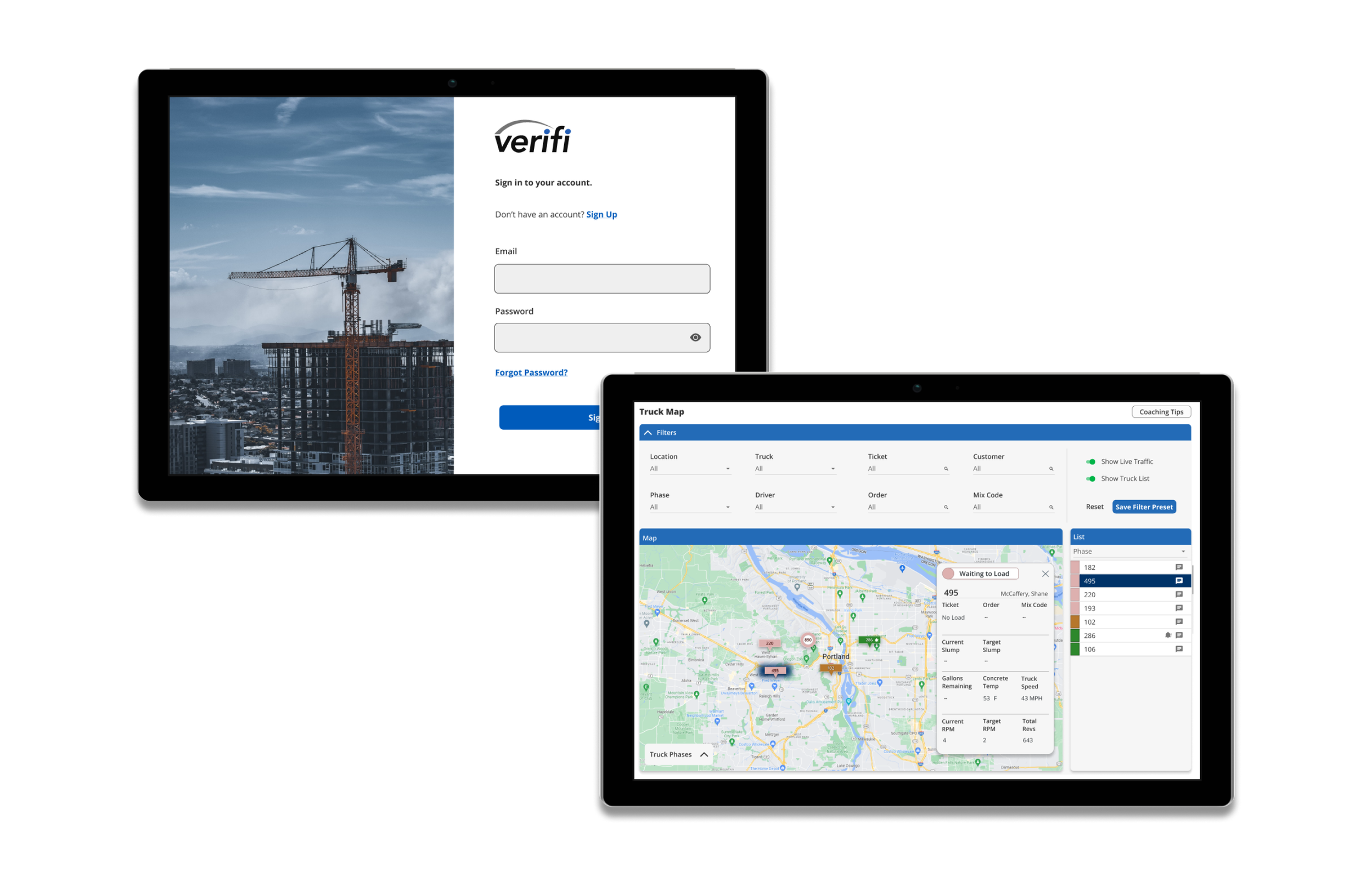
The interface shown on the left represents a more recent addition to the VERIFI portal. While it introduced a fully blue truck map and robust functionality, it was integrated into an otherwise green, legacy interface, creating visual inconsistency and contributing to an overall fragmented experience. The redesigned interface on the right preserves the same comprehensive functionality while presenting it in a cleaner, more cohesive, and simplified layout that improves clarity and usability.

The Load Reports page was a critical area of the platform, as it was among the most frequently visited pages and served as a primary source of detailed information about each concrete load. In the redesigned blue interface, I expanded this experience by introducing a dedicated Load Details page. Selecting an individual load directs users to a comprehensive view that surfaces additional data, including charts, timelines, and operational instructions, enabling deeper insight and more efficient decision-making.


Prototyping:
After completing the redesigns, I translated the work into a high-fidelity prototype to present to team members and key stakeholders. This phase required extensive interaction design and animation work to accurately reflect real-world usage. The result was a fully clickable prototype that included detailed hover states, expandable menus, pop-ups, modals, and other interactive behaviors, enabling stakeholders to experience and evaluate the proposed design in a realistic and meaningful way.


Translating to mobile:
While I typically approach projects with a mobile-first mindset, usage data indicated that the VERIFI portal was primarily accessed on desktop and tablet devices, with mobile usage being rare. Based on this insight, I prioritized desktop and tablet design during the initial phases of the redesign. In retrospect, this decision proved to be a misstep, as adapting such a feature-rich and complex platform for mobile introduced significant challenges later in the process.
Conclusion:
Undertaking a comprehensive redesign of the portal, particularly without the level of user research I would typically consider ideal, presented significant challenges. Ultimately, the project was paused before it could be fully implemented. Despite this, the process yielded valuable insights into designing complex, data-rich platforms and navigating constraints related to research, scope, and stakeholder priorities.